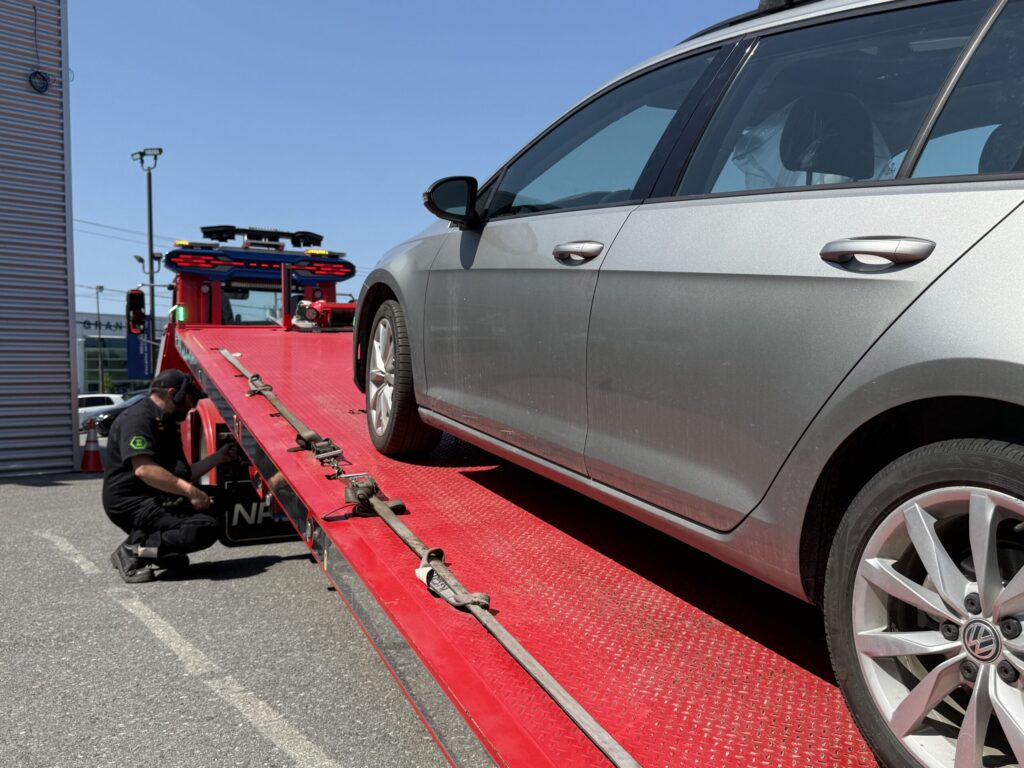
NRC is proud to celebrate the first anniversary of its electrically powered E-20TB carrier, a first-of-its-kind project that marks an important milestone in the company’s long history of innovation.
Unveiled in June 2025, the E-20TB was installed on a Mack MD Electric truck for the fleet of Remorquage Boissonneault in Granby, QC. Designed as a real-world proof of concept, the project set out to validate whether an electrically powered carrier could meet the day-to-day demands of a professional towing company.
One year later, after regular use through all four seasons — including a particularly cold Quebec winter — NRC can confidently say that the field validation phase has been successfully completed.
The E-20TB has completed more than 1,100 towing operations, representing close to 5,500 minutes of hydraulic usage and about 14,290 mi (23,000 km) travelled in urban areas, all without breakdowns or major issues. Just as importantly, the unit has demonstrated that an electrically powered carrier can deliver the same performance, reliability, and usability operators expect from a conventional NRC 20TB, while offering a quieter and cleaner alternative.
According to Benjamin Boissonneault, president of Remorquage Boissonneault: “We believe that transport electrification is part of the future, even if the industry is still in its early stages. Our experience with the E-20TB is positive: the carrier is efficient and well-suited to certain types of operations, particularly high-volume roadside assistance calls. With the available subsidies and our operational reality, the investment made sense for us. If the volume justifies it, we would certainly be open to adding a second unit.”
With the proof of concept now successfully validated, NRC looks forward to exploring future electrically powered opportunities across its carrier lineup with customers interested in innovative towing solutions. Interested customers can contact NRC directly for more information.
Additional Information – E-20TB FAQ
The following FAQ is provided to help answer common questions about the E-20TB concept and its intended applications.
How does it work?
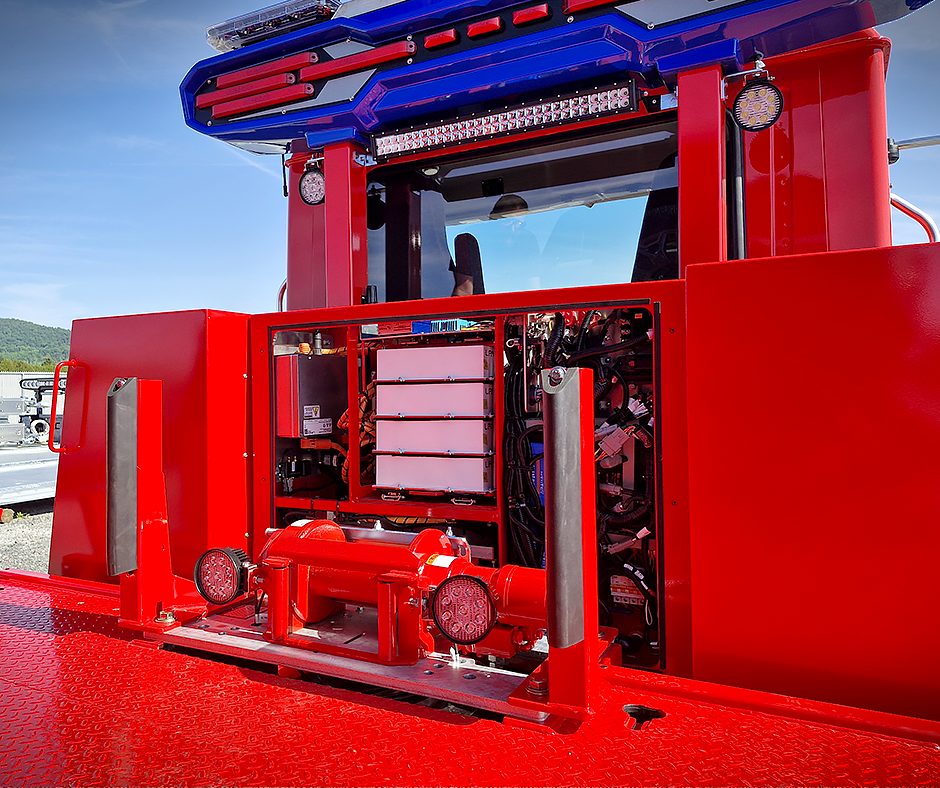
The E-20TB uses an electric power take-off (ePTO) system in place of the conventional PTO found on standard trucks. On a traditional diesel truck, the PTO is mechanically driven by the engine and powers a hydraulic pump. On the E-20TB, this function is handled by an electric motor connected to an equivalent hydraulic pump. Power is supplied by a dedicated battery pack that feeds the electric motor. This battery pack is recharged through the low voltage batteries system (12V/24V), which itself draws power from the vehicle’s high voltage batteries. The E-20TB concept can be adapted to either an electric truck or a diesel truck.
The system is activated on demand, only when a hydraulic function is used, and remains engaged for a few seconds after the function ends. This short delay helps maintain pressure during precise operations such as controlled jogs while unloading. Because the system runs only when needed, it also helps reduce oil temperature compared to a continuously running conventional setup.
Why does this make sense in the towing industry?
Aside from the ePTO and battery pack, the E-20TB is built and operated like a conventional NRC 20TB. It delivers the same towing performance operators expect and is designed to handle repeated towing operations in real working conditions, including cold-weather environments. Based on NRC’s field observations, a standard towing operation typically consumes approximately 1 kWh of energy. The ePTO system is equipped with an 8 kWh battery pack, giving operators enough reserve for multiple consecutive hydraulic operations throughout the day. The battery pack recharges while the truck is in motion.
In practical terms, the E-20TB is best suited for short-range calls in urban environments, where reduced idling, lower emissions, and quieter operation can provide meaningful advantages. For now, long-distance and highway-heavy operations remain more dependent on the base truck’s driving range and charging strategy, both of which continue to evolve rapidly.
How much does it cost?
At current pricing, the ePTO system and battery pack represent an additional investment in the tens of thousands of dollars compared to a conventional configuration. Return on investment is still being evaluated, but because the carrier can operate with the truck’s engine off, customers can reasonably expect savings from reduced fuel consumption, engine wear, and idling-related maintenance costs. Depending on your territory, additional subsidies, grants, or electrification incentives may also help offset part of the investment.
For more information, to schedule an interview, or to request high-resolution images, please contact: Olivier Poulin, Communications & Marketing Manager, 450-379-5797 #226